
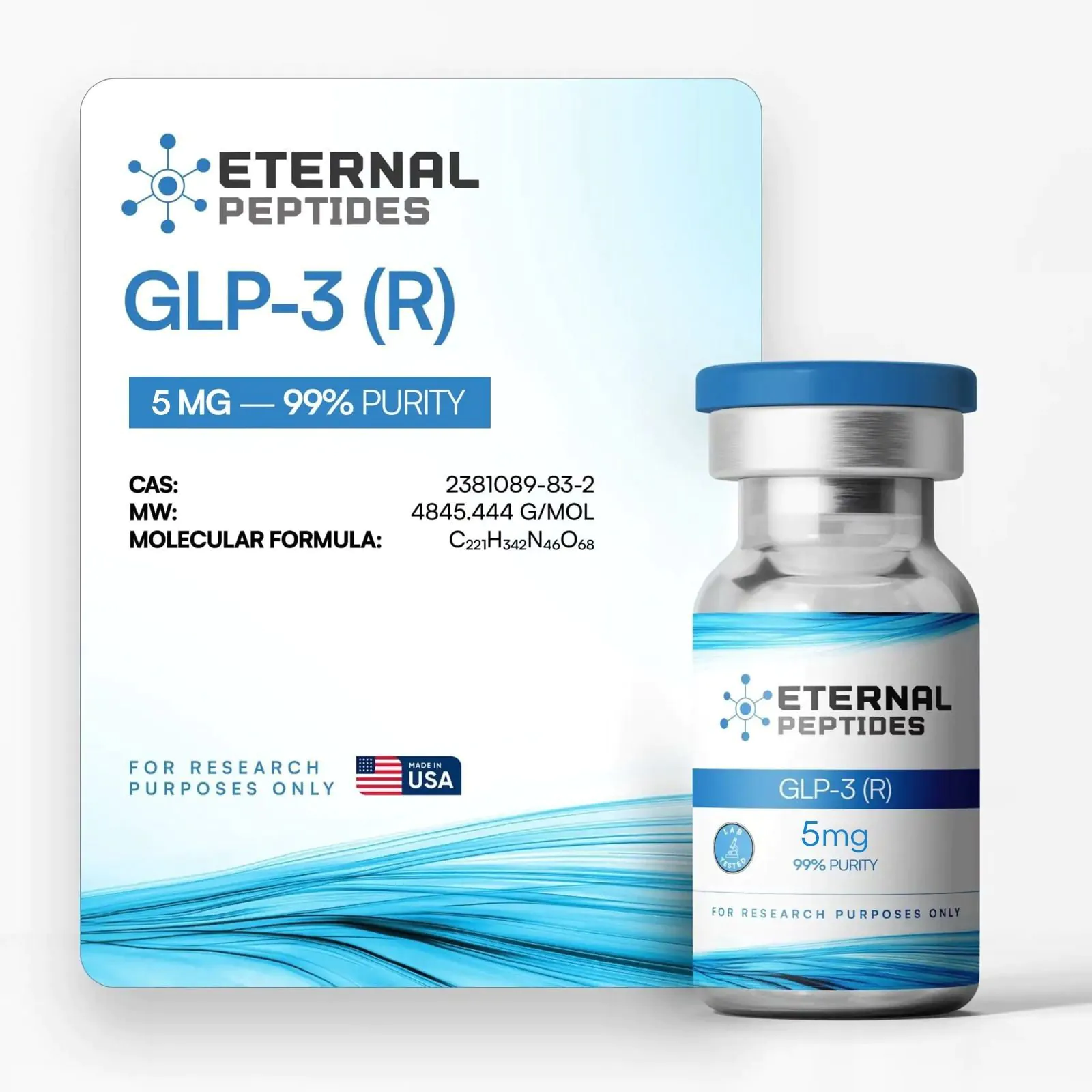
Shop GLP 3 Peptide in 10 mg and 20 mg vials. Eternal Peptides ensures rigorous testing, full traceability, and certified 99%+ purity backed by third-party COAs. Order GLP-3 (R) today to enjoy fast, secure U.S. shipping and responsive customer support.
What Is the GLP 3 Triple G-Agonist Peptide?
This molecule is a synthetic triple-agonist research peptide engineered to interact with three key metabolic receptor families commonly studied in energy-balance and nutrient-signaling research. By simultaneously engaging multiple G-protein–coupled receptor pathways, this peptide allows investigators to model highly integrated metabolic responses that cannot be reproduced with single or dual-agonist compounds.
Why Buy From Eternal Peptides?
Eternal Peptides takes customer confidence and privacy with the utmost seriousness. We’re one of very few peptide shops that accept Cashapp, Zelle, and Bitcoin payments. Shipping is secure and discreet, with each order carefully packed to ensure the integrity of the vials and their contents.
We do our best to process orders within 24 hours and ship via USPS Priority (2–4 business days) or 1–2 day Express. We also offer free Priority shipping on orders over $200.
In keeping with international standards, Eternal Peptides maintains rigorous quality and purity standards, and every peptide batch is independently tested for purity, sterility, endotoxins and heavy metals – we don’t cut corners. We ensure complete traceability and batch-to-batch consistency for complete research confidence.
Enjoy responsive support & customer care: Contact us by email or message, and our team typically replies within 12 hours (max 24h).
Plus, we have amazing bundle savings and discounts: Save more when you build larger stacks or subscribe to our newsletter and let us be your long-term research partner.
How GLP 3 Triple-G Agonists Work (Research Perspective)
Triple-agonist peptides are designed to activate three distinct yet interconnected metabolic hormone receptors: GLP-1R, GIPR, and GCGR. In non-clinical and early clinical research, this coordinated receptor engagement has provided a unique window into how multiple metabolic pathways interact when stimulated simultaneously.
Modulation of Nutrient-Responsive Metabolic Pathways
Studies show that triple-agonists influence metabolic circuits responsible for nutrient sensing, fuel selection, and substrate utilization[1]. By engaging incretin receptors alongside the glucagon receptor, these peptides help researchers observe how the body shifts between glucose and lipid metabolism, how nutrients are partitioned across tissues, and how hormonal signals regulate anabolic vs. catabolic states.
Influence on Energy-Expenditure Signaling
GCGR activation adds an important energetic dimension. In research models, triple-agonists have been associated with increased thermogenesis, enhanced fat oxidation, and shifts in resting energy expenditure[2]. These findings allow investigators to examine how incretin signaling and glucagon pathways interact to regulate whole-body energy balance.
Effects on Glycemic and Endocrine Feedback Loops
Because the three receptors jointly regulate insulin secretion, glucagon suppression, hepatic glucose output, and appetite cues, triple-agonists offer a powerful tool for studying endocrine feedback systems. Researchers can observe how hormonal cross-talk contributes to glucose control, insulin sensitivity, and compensatory mechanisms triggered by prolonged receptor stimulation[3].
A Model for Multi-Hormonal Receptor Activation
Triple-agonists provide an experimental framework for exploring multi-pathway receptor activation, enabling mechanistic studies not possible with mono- or dual-agonist compounds[4].
This includes mapping receptor-specific contributions, evaluating synergistic effects, and analyzing downstream signaling networks across metabolic tissues such as liver, adipose, muscle, and the central nervous system.
Research Value of Triple-Agonist Compounds
The combined receptor-activity profile of triple-agonists makes them particularly valuable for:
- Metabolic research (fuel utilization, energy balance, thermogenesis)
- Endocrine studies (insulin–glucagon dynamics, hormone feedback loops)
- Appetite-signaling investigations (central regulation of hunger and satiety)
- Glucose-modulation experiments (insulin secretion, hepatic glucose output)
- Systems-level metabolic modeling
By enabling simultaneous modulation of multiple hormonal axes, triple-agonists help researchers interrogate complex physiological interactions that cannot be replicated with single-pathway agents.
Peptide Characteristics
| Property | Details |
| Type | Synthetic triple-agonist research peptide |
| Form | Lyophilized powder |
| Purity | ≥ 99% (third-party verified) |
| Sequence | Provided on COA |
| Molar Mass | Provided on COA |
| Synonyms | Multi-receptor agonist peptide / Triple-pathway agonist peptide |
| Storage | Store at -4 °F (–20 °C) dry, protected from light |
| Reconstitution | Use bacteriostatic water or other sterile research-grade solvent as appropriate |
Handling & Storage Guidelines
- Keep lyophilized powder refrigerated or frozen at -4 °F (–20 °C).
- Protect from humidity and direct light.
- Use sterile water or appropriate solvent for reconstitution.
- Avoid repeated freeze–thaw cycles by aliquoting.
- Follow laboratory SOPs for sterile handling and disposal procedures.
Certificate of Analysis
Eternal Peptides is committed to providing clear, traceable documentation to support peptide quality and purity. Every vial is accompanied by a third-party COA detailing:
- Purity level
- Identity confirmation
- Chromatographic profile
- Molecular weight analysis
- Solubility notes
COAs are available on our Lab Tests page or upon request.
Regulatory Disclaimer
Eternal Peptides sells Triple-G agonists exclusively for research applications. This product is not for human or veterinary use. It is not intended for diagnostic, therapeutic, or clinical applications.
Buyers agree to adhere to all local, state, and federal regulations upon purchase of this product.
Product FAQ for Researchers
Does GLP-3 work for weight loss?
GLP-3–type triple-agonist peptides are currently studied in metabolic research models investigating energy balance, nutrient signaling, and endocrine feedback mechanisms. In experimental systems, researchers examine how simultaneous activation of GLP-1R, GIPR, and GCGR influences metabolic signaling pathways related to glucose regulation, lipid metabolism, and energy expenditure.
Despite promising observations in pre-clinical studies, please note that these compounds are research peptides and are not approved for medical use.
What is the difference between GLP-1 and GLP-3?
GLP-1 refers to a naturally occurring incretin hormone that primarily activates the GLP-1 receptor and is involved in insulin secretion and glucose signaling. GLP-3–type peptides, by contrast, are synthetic triple-agonist research compounds designed to interact with three receptor systems simultaneously: GLP-1R, GIPR, and GCGR. This multi-receptor activation allows researchers to study integrated metabolic signaling across multiple endocrine pathways.
Is GLP-3 FDA approved?
No. GLP-3 triple-agonist peptides are investigational research compounds and are not approved by the U.S. Food and Drug Administration for medical, diagnostic, or therapeutic use. These peptides are supplied strictly for laboratory research purposes, where they are studied in experimental models investigating metabolic signaling and receptor pathway interactions.
What is GLP R3?
The term “GLP R3” is sometimes used informally in research discussions to reference peptides designed to interact with three glucagon-like peptide–related receptor pathways. In the context of triple-agonist research peptides, this typically refers to compounds engineered to activate GLP-1 receptors, GIP receptors, and glucagon receptors simultaneously in experimental metabolic signaling studies.
Leading pharmaceutical company Eli Lilly has developed an approved medication that operates through a similar triple-receptor mechanism involving GLP-1, GIP, and glucagon signaling pathways. However, the GLP-R3 research peptide referenced here is an experimental compound intended solely for laboratory investigation. It is not the same as the approved pharmaceutical product and should not be considered interchangeable.
What is a triple-agonist peptide such as GLP-3?
A triple-agonist peptide is a synthetic research compound engineered to activate three metabolic hormone receptors simultaneously. In the case of GLP-3–type peptides, the primary targets are GLP-1 receptors (GLP-1R), glucose-dependent insulinotropic polypeptide receptors (GIPR), and glucagon receptors (GCGR). By stimulating multiple G-protein–coupled receptor pathways at once, researchers can study how interconnected metabolic and endocrine signaling systems respond to coordinated receptor activation.
Why are researchers studying triple-agonist peptides in metabolic research?
Triple-agonist peptides are frequently studied because they allow researchers to model complex metabolic signaling interactions across multiple hormone pathways. In experimental systems, these peptides are used to investigate nutrient sensing, endocrine feedback mechanisms, energy balance signaling, and cross-talk between metabolic tissues such as liver, adipose tissue, skeletal muscle, and the central nervous system.
How should GLP-3 triple-agonist peptides be reconstituted for laboratory research?
Triple-agonist peptides are typically supplied as lyophilized powders to preserve stability during storage and transport. In laboratory environments, researchers commonly prepare experimental solutions by reconstituting the peptide with bacteriostatic water or another sterile research-grade solvent. The solvent is generally introduced slowly along the vial wall, followed by gentle mixing to dissolve the peptide before aliquoting for experimental use.
Be the first to review “GLP-3 (R)”
Related products
Eternal Peptides For Sale
Eternal Peptides For Sale
Eternal Peptides For Sale

Eternal Peptides For Sale
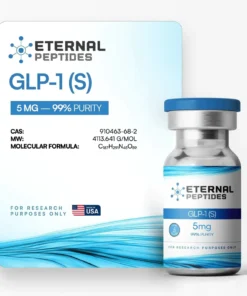
Eternal Peptides For Sale
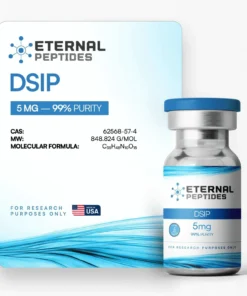
Eternal Peptides For Sale
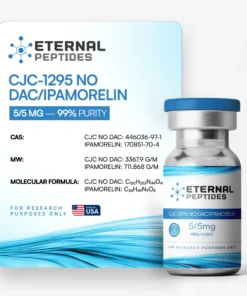

Eternal Peptides For Sale
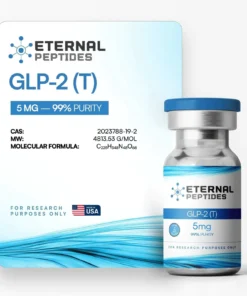
Eternal Peptides For Sale
Reviews
There are no reviews yet.